Boekestijn is well prepared for CSRD reporting
The CSRD soon requires companies to report non-financial information annually in the management report, in line with a binding reporting standard (the ESRS). Over the course of 4 months, Grant Thornton helped Boekestijn to prepare for the CSRD in a way that fits Boekestijn’s sustainability ambitions. So far, a double materiality analysis (DMA) has been conducted to determine the most relevant topics for Boekestijn to manage and report on. Subsequently, Grant Thornton helped Boekestijn prepare for implementation and readiness for reporting. This case study outlines the approach, challenges and learnings.
Step 1: Double materiality - Assessing the most relevant impacts, risks and opportunities
The double materiality assessment (DMA) is the fundament of the CSRD report, as it establishes which topics will be part of the report (and thus the strategy), form an impact as well as financial materiality point of view. Involving stakeholders in this analysis is a CSRD requirement, as this helps to better understand an organisation’s environment, effects and influence.
In line with this, Boekestijn actively engaged its stakeholders in the process of determining an initial list of relevant topics. It can be challenging for organizations to find the right set of stakeholders to involve and decide on the best method to involve them. At the same time, the process of reaching out and consulting the stakeholders can be time-consuming. Grant Thornton provided guidance to Boekestijn to set up and perform the stakeholder consultation.
First, Boekestijn opted for conducting a survey as a useful tool to gain insights into the topics that might be material. This resulted in an initial list of material topics, which was then improved with the additional insights from several extensive interviews with stakeholders, including with shareholders, customers and suppliers.
Breaking down topics
In the next stage of the DMA, the topics on the list are assessed and ‘scored’. This includes a further breakdown of a topic into specific related impacts, risks and opportunities (IROs).
- Impacts: inside-out
impacts that an organisation has on people and the environment, such as emissions associated with transporting goods on trucks and the provision of good working conditions to ensure a healthy and enjoyable working culture for its employees.
- Risks & opportunities: outside-in
referring to the impact that ESG-related developments have on the financial results of the organisation. For example, mitigating the negative impact of transport emissions by using cleaner vehicles can be an opportunity for Boekestijn to be seen as a front runner and gain a competitive advantage.
This double materiality (inside out and outside in) principle is at the core of the CSRD.
Assigning IRO scores
In the next phase, the IROs are scored on scope, scale, irremediability and likelihood (impacts) and on magnitude and likelihood (risks & opportunities). The higher the scores on these factors, the higher the materiality score of an IRO and the higher the materiality of a topic.
It can be challenging to assign a score to an IRO. Take the example of the impact of Boekestijn on GHG emissions caused by transport. Compared to annual global emissions, the emissions caused by Boekestijn might not seem significant. Nonetheless, the impact is important to Boekestijn and the company sees an essential task in trying to mitigate these emissions. Thus, the decision was to assign the score “significant” to scale.
The scope and remediability are scored as significant and high respectively as GHG emissions impact the global population and the effects are difficult to remedy for Boekestijn. Knowing where an impact, risk or opportunity occurs can provide insights that help in the scoring process. Is the impact only relevant for transport or also within procurement processes, or both?
Visualizing helps
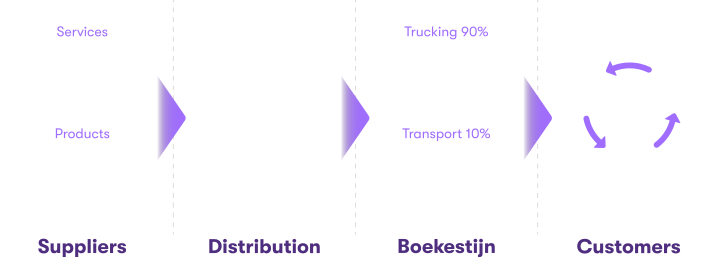
Visualizations can be used as an instrument to guide this thinking process and they help place potential IROs within a company’s value chain. Simplified value chain visualizations, such as in Figure 1, helped Boekestijn assess the potential scope and scale related to the impacts.
![Boekestijn 1]()
Figure 1
Determining definitive material topics
After completing the scoring of the IROs, the materiality threshold is determined. This threshold is established by consulting the organization and can be based on existing risk management processes and/or strategic considerations. By setting the thresholds for materiality, the list of all the material topics is finalised. For these topics, companies are required to report in line with the binding reporting standards from the ESRS. In the case of Boekestijn, the DMA resulted in five material topics that were matched with the corresponding ESRS thematic standards:
- Climate change
- Learning and skills development
- Being a good employer
- Health and safety
- Business conduct
Step 2: Closing gaps on material topics with Policies, Actions, Metrics and Targets
For each of these material topics, the CSRD requires organisations to report the relevant policies, action plans, measures and targets (PAMT) within the organisation.
Assess gaps
Boekestijn initially prioritized three material topics to conduct a gap assessment for:
- Learning and skills development
- Business conduct
- Climate change
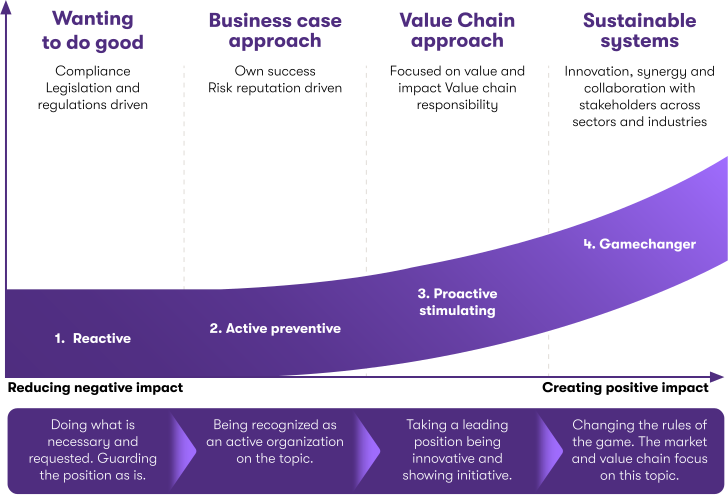
For these topics, Boekestijn assessed the current status and determined the desired ambition level using our ambition model (see Figure 2). Since CSRD is a transparency regulation, establishing the organisation’s ambition helps to guide implementation.
![Boekstijn figure 2]()
Figure 2
The gap analysis is used to identify gaps i.e. the difference between what’s currently in place for a material topic in regard to policies, actions, measures and targets, and what needs to be developed.
Implementation
The implementation then focuses on developing the missing PAMT to close the gaps. Being a transporter, Boekestijn has a direct impact on climate change through emissions caused on the road. Currently, Boekestijn is working hard to mitigate these emissions, for example by using cleaner vehicles or fuels.
CSRD requires Boekestijn to describe the policies and the scope related to such efforts, as well as the assumptions that are made, the targets and their relation to the policy objective. Moreover, CSRD requires organisations to specify the key actions and their expected outcomes along with the metrics and the methodologies used to design the metrics. Such initiatives are complex and require the right management set-up (of PAMT) to be successful.
Developing building blocks
Our consultants assisted Boekestijn in working sessions to create the aspects of PAMT, building on the work that had already been done. In these sessions, the essential building blocks to be implemented to realize the ambitions were developed and bundled into a roadmap. The management was actively involved in the work streams, which boosted ownership and helped in setting ambitions for each topic. This roadmap for implementation helped Boekestijn in prioritizing actions and smoothen its journey towards full CSRD-compliance.
Step 3: Creating the reporting framework
The next step for Boekestijn is to prepare for reporting on the CSRD, which involves
- Setting up the reporting structure
- Developing the outline of the report
- Aligning the sustainability statement with the ESRS requirements.
- Building audit files to ensure compliance and transparency throughout the reporting process.
Push through, even when it is complex!
Do not let the recent Omnibus developments with regards to the CSRD hinder your progress in embedding sustainability into your organization. A double materiality assessment provides valuable insights and can be a strategic tool to strengthen your organization. Do you have a question on double materiality, or is your organization looking for guidance and support to integrate sustainability more strategically? Contact one of our experts and discover what Grant Thornton can do for you!
Contact us