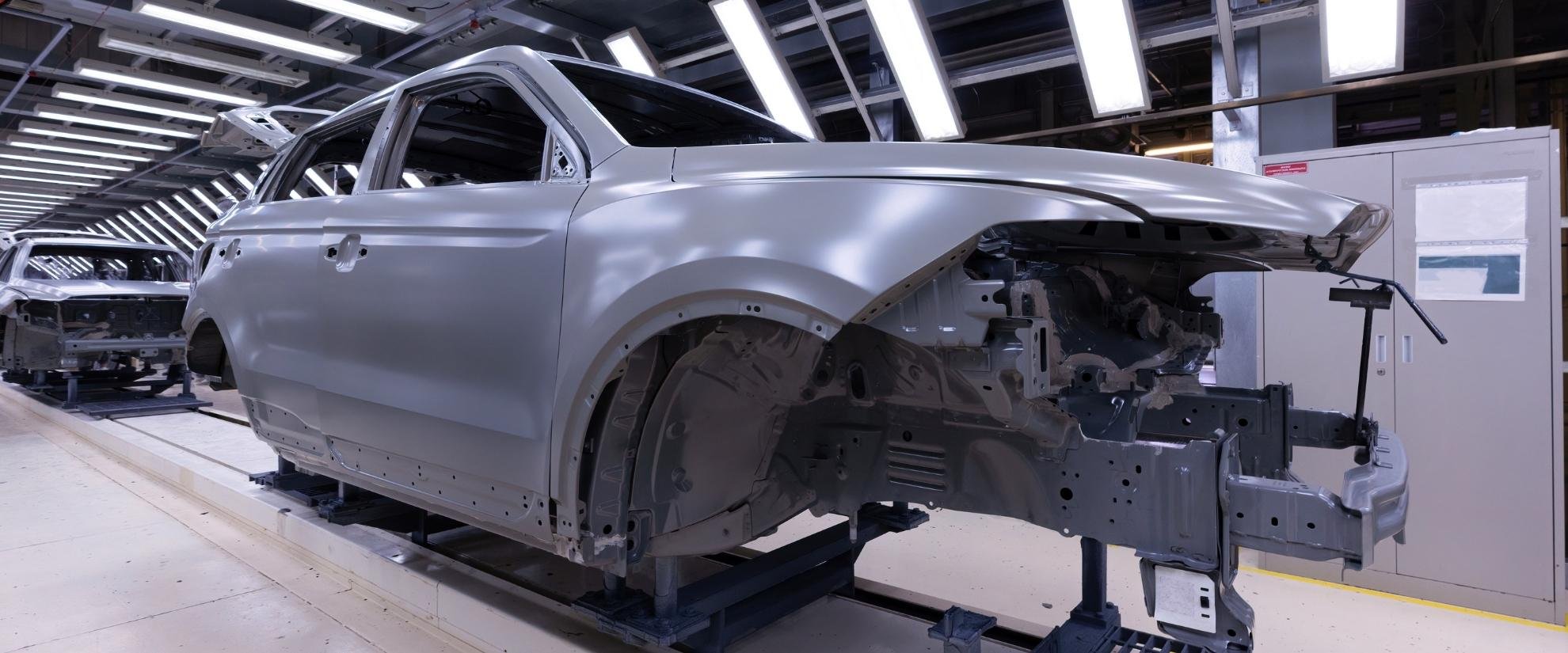
The European automotive industry is not experiencing a temporary downturn, but a structural reshuffling. In 2025, around three million fewer vehicles were produced in the European Union than in 2019. At the same time, the global car market grew, while the EU’s share remained around 14 percent. This increases the pressure on European manufacturers to cut costs, restructure production capacity, and invest more quickly in electric and software-driven vehicles.
The effects are now clearly visible among suppliers. According to European industry association CLEPA, automotive suppliers announced a total of 104,000 job cuts in 2024 and 2025. In contrast, only 7,000 new jobs were announced in 2025. At the same time, European production of electric vehicles increased by 23 percent between 2024 and 2025. The market is therefore not simply growing or shrinking, but shifting towards other technologies, capabilities and value chains.
The Netherlands is more connected than it seems
The Netherlands is not a mass producer of passenger cars like Germany, France or Spain. Yet our country is closely intertwined with the European automotive industry. Dutch companies supply components, production technology, semiconductor solutions, materials, logistics services, engineering and digital systems to international manufacturers. According to RAI Automotive Industry NL, the Dutch automotive manufacturing and supply chain industry generates around 20 billion euros in annual turnover, of which almost 90 percent comes from exports.
This export position offers economies of scale and international growth opportunities, but at the same time makes companies sensitive to decisions made elsewhere. When a European OEM cancels production models, lowers volumes, consolidates suppliers or postpones investments, Dutch suppliers can quickly feel the impact. This applies in particular to companies that depend heavily on a limited number of customers, vehicle platforms or technologies.
At the same time, the Dutch market itself shows how volatile conditions can be. In 2025, turnover in the car and motorcycle sector fell by 2.6 percent. Importers lost 9.3 percent in revenue and the heavy commercial vehicle sector saw turnover decline by 6.4 percent. In the second quarter of 2026, turnover, by contrast, increased by 13.9 percent compared to a year earlier. In passenger car trade and repair, growth even reached 19.2 percent. This turnaround highlights that one favourable quarter does not automatically mean that the underlying structural pressure has disappeared.
From OEM risk to chain risk
The greatest vulnerability often lies not in directly visible turnover declines, but in dependencies that are insufficiently monitored. Executives usually know what percentage of revenue comes from their biggest customers. It is often less clear, however, how dependent those customers themselves are on a single manufacturer, production site, drivetrain or vehicle platform.
It is therefore wise not to assess customer concentration solely at the legal customer level, but across the entire value chain. A supplier may have dozens of contracting parties that all ultimately supply the same OEM or technology. On paper, the portfolio appears diversified, whereas economically it represents a concentrated risk.
It is also relevant to distinguish between revenue linked to traditional combustion engines and revenue related to electric, connected or software-driven vehicles. Electrification not only leads to different drivetrains, but also to a changing demand for parts, maintenance and technical expertise. In 2026, for example, Statistics Netherlands (CBS) noted that demand for certain components is decreasing, partly because electric vehicles contain no combustion engine or traditional gearbox.
Four questions for the boardroom
How concentrated is our actual revenue?
Look not only at direct customers, but also at the OEMs, vehicle programmes and technologies behind them. Then map out what happens if an important production programme is scaled down by 10, 20 or 30 percent.
Which capacity may become structurally redundant?
Production assets and specialist knowledge developed for one vehicle platform are not always easy to deploy elsewhere. An early assessment of alternative applications can prevent capacity from being reduced only after losses have already occurred.
Can we finance the transition ourselves?
Investments in automation, electrification, data and more sustainable production often coincide with pressure on prices and volumes. This calls for scenarios on liquidity, working capital, financing covenants and investment room.
What position do we want to take in the future value chain?
Not every supplier needs to develop new technology themselves. Collaboration, acquisitions, joint ventures and access to other sectors can also contribute to a future-proof portfolio.
Waiting is also a strategic choice
The restructuring of the European automotive industry does not mean that every Dutch supplier will encounter difficulties. The growth of electric mobility, digitalisation and new mobility services actually creates new market opportunities. In 2025, roughly one in four vehicles produced in Europe was expected to be battery-electric or plug-in hybrid.
But opportunities do not arise on their own. Companies that gain early insight into their customer dependency, technology position and financial capacity can invest, diversify or cooperate more strategically. Companies that wait for definitive certainty risk that the market will already have shifted towards a different value chain.
What can you do now?
Bring together revenue dependency per customer, OEM, platform and technology in a single scenario analysis. Link this to the expected impact on capacity, cash flow and investment headroom. In this way, you translate an international market development into a concrete Dutch boardroom agenda.
Would you like to discuss these insights further? Contact us.
Authors
-

Annemieke Bos
Annemieke is an expert in impact strategy, ESG, impact measurement, and reporting, with in-depth knowledge of GRI, IIRC, SDGs, SFDR, EU Taxonomy, and CSRD regulations.View Profile -

Erwin Rexwinkel
Erwin Rexwinkel is a Partner and, since 1 July 2025, has led the Specialist Advisory Service Line at Grant Thornton Netherlands.View Profile