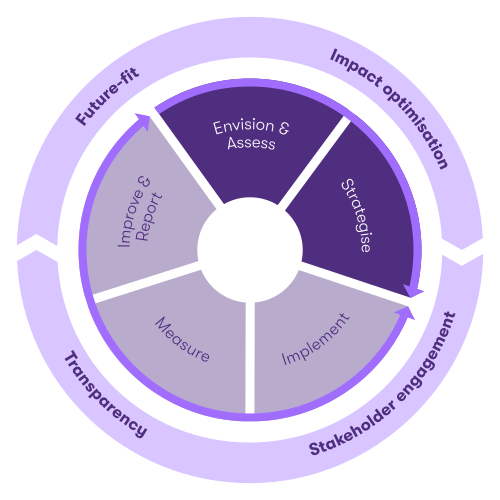
An ESG benchmark helps organisations gain insight into a rapidly changing market and supports the strengthening of their own positioning. It is an important instrument for building a future‑fit business model (see image). In a time when regulations, stakeholder expectations and market developments evolve quickly, benchmarking offers a way to manage risks, seize opportunities and realise competitive advantage. In this article, we explain this further.
![]()
What is an ESG benchmark?
An ESG benchmark is an analysis that compares the positioning of an organisation with its peers on relevant ESG themes. Strategic information from different companies is systematically compared. There are various types of benchmarks: strategic, thematic and reporting‑level.
A benchmark can relate to a complete sustainability report, but increasingly, specific themes such as climate are the focus of the benchmark. On selected topics, the approach, level of ambition and best practices are examined. This enables organisations to refine and future‑proof their sustainability strategy. ESG benchmarks are not only used by organisations themselves; investors also make extensive use of available data and targets.
Why does ESG benchmarking have strategic value?
By comparing publicly available ESG data, insight emerges into relevant market developments. What is happening in your sector? Which developments do you see in sustainability themes in which your organisation aims to excel?
Benchmarking helps align the ESG strategy with market trends and stakeholder expectations. Continuing to steer on these developments is crucial for long‑term value creation. A benchmark is never merely a paper exercise but ideally a driver for improving impact and making better strategic choices. In addition, benchmarking is a continuous process rather than a one‑time exercise.
The benefits:
- It increases insight into sector trends, best practices and challenges, both in general and per ESG theme.
- It serves as input for setting ambitious targets and determining strategy.
- It helps determine a distinctive position compared to competitors.
When should you conduct an ESG benchmark?
In addition to external benchmarks, organisations can conduct ESG benchmarks themselves at various points. Two examples:
- Strategic ESG benchmark after identifying material themes
A logical moment for a benchmark is after identifying the organisation's relevant ESG themes, which is often after completing a DMA. A DMA includes sector research, which provides insight into trends, developments and points of attention. This results in a clear picture of which ESG themes are important for comparable organisations. These insights provide valuable input for the DMA, because similar themes are often relevant within the same sector.
After completing the DMA, it is valuable to determine how current efforts and ambitions compare to other players in the market. This offers direction for strategic choices: does the ambition align with the organisation’s positioning, its strategy for the coming years and the pace at which it wants to develop? Benchmarking often leads to valuable board‑level discussions and provides concrete insights to strengthen strategic direction or seize new opportunities.
- Thematic ESG benchmark for future‑proof impact
Organisations want to create an impact that aligns with their ambition. For example, if an organisation wants to excel in circularity, it is essential to understand what is happening in this area, where opportunities lie and how it compares to competitors. This can be achieved by regularly conducting ESG benchmarks. Inspiration can be drawn both within and outside the sector, for example, from frontrunners promoting and implementing circular innovation. These insights support continuous improvement and innovation on key ESG themes, helping to future‑proof impact.
In addition to these moments, an ESG benchmark is also valuable when developing policies, setting targets and during the reporting phase.
Comparison criteria dependent on strategic goals
The value of a benchmark depends on its purpose: do you primarily want insight into what competitors are doing, or do you want to define a strategy for the coming years? The purpose determines the criteria used for the benchmark.
Key criteria:
- Focus: do you look at a specific theme or compare the general ESG ambition?
- Scope: do you compare within the sector, with organisations of similar size, or with organisations pursuing similar ambitions?
- Sources: do you use annual reports, sustainability reports, websites or external benchmarks? Decide in advance which sources are the most useful and reliable.
Keep the benchmark pragmatic. A benchmark with many criteria and a large peer group can quickly become extensive and lose depth. Clear boundaries keep it manageable and more valuable.
ESG benchmarking in practice
We regularly conduct ESG benchmarks for our clients. Some examples:
- For a large logistics company, we conducted a benchmark to inspire the development of a climate target. We mapped peers' climate targets, which provided valuable input for a joint brainstorming session. This resulted in a climate target aligned with the organisation’s ambitions.
- For a financial institution, we conducted a benchmark on ESG reporting in preparation for the 2024 annual report. The goal was to produce an ambitious report. By gaining insight into the reporting level of peers, the organisation was able to match and exceed this level. Additionally, insights emerged for next steps at a strategic level, for example, integrating material impacts, risks and opportunities into daily operations.
Future‑fit organisation
Benchmarking is not an end in itself but a mechanism to define direction and accelerate impact. Organisations that structurally use ESG benchmarking build a future‑fit strategy and strengthen their market position. Continuous insight into market developments and positioning on relevant ESG themes enables organisations to substantiate strategic decisions, make timely adjustments and increase impact. This keeps the organisation prepared for the future.
Which ESG themes are critical for your organisation to benchmark strategically in the coming year? Map them out and start your benchmark.
Contact
Would you like to know more? Contact Grant Thornton Impact House for an introductory meeting or sparring session.
Contact us