As much as 86 per cent of forced labour occurs in the private sector and affects industries ranging from services, manufacturing, and agriculture to construction. This means many products used and consumed today may be directly linked to forced labour.
What is considered forced labour?
The International Labour Organization (ILO) defines forced labour as “all work or service extracted from any person under the menace of penalty and for which the person has not offered himself voluntarily”. This includes coercion through threats, violence, debt bondage, withholding identity documents, or other forms of exploitation.
As concerns about forced labour continue to rise, businesses face mounting pressure from regulators, investors, and the public to review their supply chains and address these practices. One of the most significant developments is the EU Forced Labour Regulation (FLR).
What is the FLR?
The FLR prohibits companies from placing products on the EU internal market or exporting products from the EU if they have been made using forced labour. This also includes products made using forced child labour. The Regulation applies to all companies, industries, and product types, regardless of where the goods originate. The requirements will take effect on 14 December 2027. Companies can prepare by conducting appropriate due diligence.
Unlike broader corporate due diligence obligations, such as those under the CSDDD or CSRD, the FLR does not impose general company‑level requirements. Instead, it is a product‑based market access regulation, similar to the EU Deforestation Regulation (EUDR), but global in scope and focused on the presence or risk of forced labour at any stage of a product’s lifecycle.
Scope of the FLR
The FLR applies to products at all stages of their lifecycle, including but not limited to:
- production, manufacturing, harvesting, or processing
- both EU‑produced and non‑EU‑produced goods
- online or distance sales, including modern retail channels
Transport services are explicitly excluded, keeping the focus on products and their components.
The regulation applies to all companies, referred to as economic operators, regardless of their size, sector, or geographical location. Any business that places products on the EU market or exports goods from the EU, whether through physical sales channels or online platforms, falls within its scope.
Definition of ‘economic operator’: Any natural or legal person or association of persons placing or making available products on the Union market or exporting products.
Core functions of the FLR
- prohibits products suspected of having been made using forced labour from entering or circulating
- empowers the European Commission and national authorities to investigate and take enforcement actions, such as bans and product withdrawals (in most Member States, the enforcement bodies have not yet been publicly announced)
How will the FLR work in practice?
While the regulatory requirements are set, further guidance is expected soon. The European Commission is scheduled to publish implementation guidelines by 14 June 2026, which will provide businesses with more clarity. To prepare for this, the Commission recently closed its call for evidence, receiving 160 responses from stakeholders including businesses, civil society organisations and researchers.
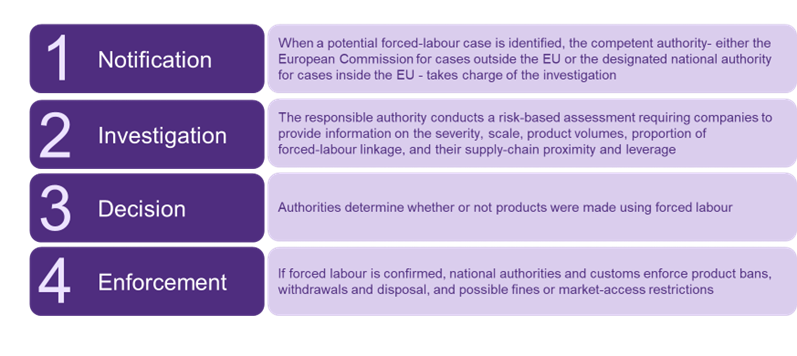
However, the key elements of the regulation have already been defined. The Netherlands Enterprise Agency (RVO) has summarised these in a helpful flowchart. The core steps are:
![]() Once a company has removed forced labour from its supply chain, its products may re‑enter the EU market.
Once a company has removed forced labour from its supply chain, its products may re‑enter the EU market.
The European Commission has also published a draft Implementing Regulation outlining how authorities will coordinate and exchange information during FLR investigations. Although aimed at regulators rather than companies, it will influence how enforcement works in practice.
The consequences are clear: failing to meet FLR expectations can lead to operational disruption and financial loss. Early preparation is essential.
How and when to prepare for the FLR
Although the EU guidelines are still forthcoming, companies can already begin preparing to ensure compliance by 2027. Meeting the requirements of the FLR will require due diligence aligned with international standards, such as the OECD Guidelines for Responsible Business Conduct and the UN Guiding Principles on Business and Human Rights.
Some no‑regret actions include:
- mapping supply‑chain risks and identifying high‑risk areas
- beginning engagement with high‑risk suppliers
- strengthening due diligence processes aligned with OECD standards
- preparing to document and provide information quickly during investigations
- monitoring the implementation guidelines published by the European Commission and adjusting internal procedures accordingly
How can we help?
At Grant Thornton Impact House, we help clients future‑proof their business by building effective human rights and environmental due diligence systems. From value‑chain mapping to risk assessments and supplier engagement processes, we help organisations develop a robust approach that supports compliance with various regulatory due diligence requirements, including the Forced Labour Regulation.
Would you like to discuss these insights? Get in touch with us.
Contact us

 Once a company has removed forced labour from its supply chain, its products may re‑enter the EU market.