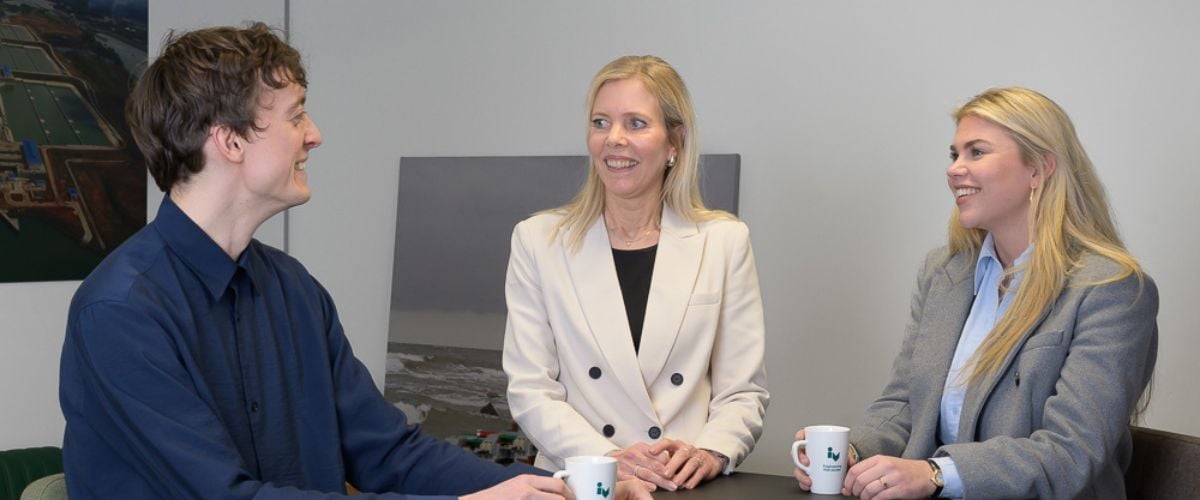

Yes, legislation is coming. The Pay Transparency Directive (EUPTD) forces companies to close the pay gap between men and women and to be transparent about any differences. But this upcoming legislation, which must be transposed into national law across Europe by June 2026, was not even the main reason for Iv to commission this pay gap analysis. “For us, it is completely self-evident to pay men and women equally,” says HR manager Joke Walta. “We are intrinsically motivated in this.”

Iv Joke

The company culture of Iv

Joke Walta has been working at Iv for twenty years. It is a people business, with hard workers and a heart for technology. At Iv, they work on super-complex and highly impactful technical solutions for, among other things, the energy transition, all over the world. Although Iv has become increasingly visible externally in recent years, the company from Papendrecht remains strikingly modest.

Not expected

This identity, the company culture in the corridors, but also the diversity policy that Joke and her HR colleagues pursue, does not fit with inequality. And yet there seemed to be a small pay difference. This emerged from an initial general benchmark that Iv commissioned when it was working on a new job framework in 2024. That study also showed that employees at Iv are well paid and can count on excellent secondary employment conditions. “I did not expect a difference to emerge,” says Joke. “You think that we do this well, that we pay men and women the same. We also steer on this during our annual pay rounds.”

Diving deeper into the pay gap

The outcome prompted Iv to want to delve deeper. The engineering consultancy therefore came into contact with Grant Thornton, which was already working with Iv in other areas such as accountancy and assurance. Grant Thornton helped with a detailed pay gap analysis (Paycheck’ed) to properly explain the pay differences. “We really wanted to know how things stood. And to work on it,” says Joke. “Of course, we also had countless questions.” Questions such as: how is the age development of men and women factored in? What about work experience? What if there are far more men than women working at the company?

Making the pay gap transparent

“It is a new service that we offer,” says Anne-Fleur. Together with Tom van Mierlo, she explains that there is an unadjusted and an adjusted pay gap. The unadjusted gap is ‘simply’ the actual percentage difference in pay between men and women. This did exist at Iv, as it does at many other companies. But that difference can largely be explained by various relevant factors, such as the distribution of roles between men and women and work experience. When all these factors are taken into account, the adjusted pay gap can also be determined. This is naturally smaller, and that was also the case at Iv. Due to the policy that Iv pursues, the pay gap is very small.

About the pay transparency directive

Grant Thornton’s service anticipates upcoming legislation. Anne-Fleur explains: “The European Pay Transparency Directive (EUPTD) obliges companies to provide transparency in pay.” The European legislation will come into force halfway through this year, but the Netherlands has requested a postponement. Once the law has been implemented in the Netherlands, transparency must be provided to employees about pay, pay levels and pay development. In addition, the pay gap must be reported to the competent authorities. Employees will also gain the right of access. This means that employers must provide insight within two months into the average pay level of employees performing the same work. “It is very good that a company like Iv opens itself up to having this investigated in order to be well prepared for these obligations. It is quite a sensitive topic. That speaks in Iv’s favour,” Anne-Fleur believes.

Culture plus the figures

Tom sees it at many companies: “You do not see it, you do not feel it, but there is still a difference in pay. You cannot rely solely on company culture for equal pay,” says Tom. “You must also have substantiating figures. By having good insight into the figures and a policy focused on equal pay, that pay gap is gradually closed. It is a process of years. As long as you are aware of the figures.” Nor should you make assumptions to explain pay differences, Tom advises.


IV tom

Joke knows this too: “I had an assumption that the supporting staff departments were paid less than the technical roles, which are the heart of the organisation.” That turned out not to be the case. Some companies are so convinced that they pay equally that a potential pay gap is not even investigated, Tom knows.

“We think we have no pay gap, so there is none. At Iv they dare to step beyond that conviction and still conduct further research to be able to offer certainty.”
Tom van Mierlo Impact consultant at Grant Thornton

Tip: collect HR data

Quite a lot of data is needed for Grant Thornton’s pay gap research. “Fortunately, the data was already well available and in order,” says Tom. He immediately gives a tip to other organisations: make sure you collect as much data as possible and classify it properly. “All the objective data you have helps to explain pay differences between men and women.” If, for example, men within the company have on average more years of service than women, that is an explanation for why salaries differ.

anne-fleur iv

Or there may be a difference in education level between men and women. “You are allowed to pay differently, as long as you can objectively explain why the salaries differ,” Anne-Fleur adds. “If the pay gap is above 5% and you cannot explain it, you really have to take action.”

Benefits of a pay gap analysis

After Grant Thornton completed the analysis for Iv, Joke and her colleagues were presented with the outcomes. Joke recalls: “It was good to be taken along in the research, because it is quite complex subject matter. Tom and Anne-Fleur extensively outlined the different perspectives on the topic. You can look at the outcomes from a mathematical and a legal perspective.”

In addition, Joke found it valuable to hear which explanations you can take into account when calculating the adjusted pay gap and which you cannot. “And to receive practical guidance on how to further close the pay gap. You really have to understand how it works in order to be able to take action.” For a moment, Joke had considered solving the puzzle of different data points on pay herself. Just for a moment.

“Still, it is nice if an external party takes this off your hands. That saves a lot of time. And then you also know that it is done properly.”
Joke Walta HR manager at Iv
Iv alle drie

Tom responds: “That we can solve mathematical equations is not the point. The complexity in such an analysis lies in which variables we include in our research to explain the pay gap and how we subsequently interpret the outcomes legally.” Joke also appreciated having the legislation explained clearly. “You read a lot in the media, but that is often insufficient. The nuance is missing. That is why it is comfortable to be taken step by step through this Pay Transparency Directive.”

Not making it look better than it is

Joke experienced the collaboration with Grant Thornton as pleasant. “I am sure that I can simply call you if I still have questions.” Tom and Anne-Fleur nod, of course. And something else that Joke appreciated: “You do not make it look better than it is.” Conversely, Tom and Anne-Fleur were also pleased with Iv as a client for this relatively new service. Anne-Fleur: “What I like is that Iv is not doing this research merely to comply with the law. The organisation is intrinsically motivated to pay equally and dares to have an open conversation with us about this. Moreover, we were able to communicate with each other in an open and smooth way, which was very pleasant.”

Technology first, equal pay self-evident

Iv is pleased with the insight that the pay gap analysis has provided. For Iv, this report forms a benchmark to continue to critically review the figures together with HR during future pay rounds and to optimise the policy where necessary. She concludes with the guiding principle: “We consider equal pay completely normal.” That Iv, with the openness of this research, is distinctive in this respect does not bother her: “We do not necessarily need to tell people how well we do this. We would rather show that through our technical projects!”

The video is playing. This video is playing in mini-player mode.