Companies that actively engage stakeholders pick up signals early, create understanding and find solutions together before problems escalate. But what do you do when customers ask about the origin of products, an NGO criticises you, the trust of your investors falters, or you want to maintain employee pride?
Many companies find it difficult to embed stakeholder engagement structurally. This article shows how to reap the strategic benefits when developing and implementing your sustainability approach.
The benefits of stakeholder engagement in sustainability strategy
What is stakeholder engagement?
Stakeholders are all the parties you affect or influence you: employees, customers, investors, industry associations, local communities, and broader society. Stakeholder engagement means actively building strong relationships with these parties. By taking expectations and concerns seriously and responding to them, trust, shared values, and sustainable value creation can emerge. Real engagement goes beyond informing or consulting: you decide and shape policy together.
From insight to better policy
You gain visibility into what matters by involving employees, customers, investors, and the community in decisions and measures. This lets you formulate relevant goals, identify risks and opportunities early, and better anticipate social developments.
Engagement also increases support and transparency in decision-making. Stakeholders gain a clearer understanding of how choices are made. Pressure for openness is increasing: customers want to know where products come from, investors ask about climate risks, and employees expect clarity on corporate social responsibility (CSR).
When stakeholders feel taken seriously, they connect with the strategy. People take responsibility for implementation more readily and are more likely to speak out in favour of it publicly. Engagement thus leads to behavioural change and more effective policy.
Voluntary or mandatory?
Will you soon fall under the Corporate Sustainability Reporting Directive (CSRD) or the Corporate Sustainability Due Diligence Directive (CSDDD)? Then, structural stakeholder engagement is mandatory. You must demonstrate whom you consult, how you do it, and how you use input when determining material impact, risks and opportunities (including in the supply chain). Stakeholder dialogue is thus a building block for double materiality, supply chain analysis and risk management. Not covered by these laws? You can still use the standards as guidance for carrying out and documenting structured and comparable engagement. This ensures a more effective sustainability policy.
How to take the first steps towards structural stakeholder engagement
Step 1: Identify stakeholders
Link your key activities to the parties you influence or who influence you. Think beyond the “usual suspects”: who has authority, resources, and relevant knowledge, or is directly affected?
Step 2: Define the role and form per group
What do you want to achieve with the relationship? What role can stakeholders play in your approach? Choose the form: one-off consultation, knowledge sharing, long-term collaboration or structural involvement in decision-making. Also, assign internal ownership.
Step 3: Start the conversation
Explore needs, concerns and expectations. How do stakeholders perceive your company? What matters to them? This builds relationships based on transparency and shared interests.
Step 4: Acknowledge tensions and exchange views
NGOs, shareholders, trade unions and local communities may have different priorities. Listen, prioritise, be transparent about trade-offs and manage expectations. Where possible, bring stakeholders into dialogue with each other.
Examples for each phase of your sustainability steering
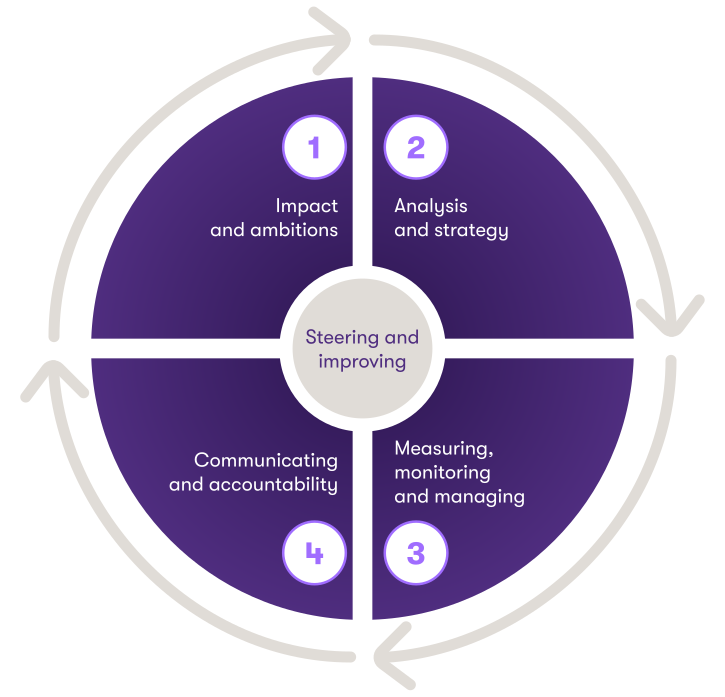
Stakeholder engagement is not a stand-alone project, but a continuous cycle (see figure 1).
![]()
Impact and ambitions
Start by understanding your positive and negative impact, risks, and opportunities. Use existing channels: customer surveys, employee polls, supplier talks or dialogue tables with the community. This way, you gather targeted input on relevant themes and ambitions.
Analysis and strategy
Translate ambitions into goals, policies and projects. Actively involve stakeholders through consultation rounds, advisory groups or co-creation sessions.
Measuring, monitoring and managing
Jointly determine the right performance indicators. Stakeholders can serve as information sources (surveys, feedback, interviews), data providers (supplier reports) or signalling parties (NGOs, social partners). This enhances the relevance, reliability and applicability of your data.
Steering and improving
Use results for concrete improvement actions, together with your key stakeholders. Organise sensemaking sessions: reflect on the results, interpret them and translate them into actions. This creates shared insights, better decision-making and a strong learning culture.
Communicating and accountability
Communicate openly about progress, dilemmas and performance. Start from your audience’s information needs: investors often want detailed reports; employees benefit from a visual summary or internal newsletter; consumers can be reached with an accessible video or interactive page. Use reports as an invitation to dialogue: ask for feedback, organise Q&As or use interactive formats.
International context
For large and international companies, engagement becomes more complex. Differences in culture, language, local context and power dynamics call for an inclusive and local approach. Also, ensure there is an accessible complaints mechanism. International guidelines such as the UN Guiding Principles on Business and Human Rights (UNGPs) and the OECD Guidelines require that stakeholders be able to submit complaints about (potential) negative impacts. This is responsible business conduct and helps identify risks early.
The cycle starts again
Thus, the cycle of integrated sustainability steering comes full circle and starts again. New insights form the basis for your next step in impact, ambitions, and priorities. You also keep your stakeholder engagement system active.
How we can help
We support organisations in developing and strengthening their sustainability strategy, with stakeholder engagement as a fixed component. From the first steps such as stakeholder mapping to effective governance. And from involvement in formulating ambitions to monitoring, improvement and communication: we ensure engagement is not a one-off activity but structurally embedded. We work with smaller organisations in the Netherlands and with international organisations with complex stakeholder networks.
Are you curious about what we can do for your organisation? Feel free to contact one of our specialists. We would be happy to discuss your ideas with you!
Contact us