What is PPWR?
The PPWR changes the rules of the game for packaging within Europe by replacing a fragmented patchwork of national rules with one harmonised standard for design, recyclability, labelling and reporting. It replaces the 30-year-old Packaging and Packaging Waste Directive (PPWD), which each country translated into national law and interpreted differently. As a result, international businesses have had to navigate 27 versions of what were effectively the same requirements.
By applying directly and consistently across all member states, the PPWR removes this fragmentation and provides organisations with one clear set of rules to design and report against when operating in Europe.
The PPWR applies regardless of company size and affects almost any organisation that places packaging on the EU market. This differs from the Corporate Sustainability Reporting Directive (CSRD), where thresholds were recently raised so that fewer companies fall within scope. The PPWR also does not stand alone. It connects directly to the broader circular economy agenda and to regulations on value chain transparency, waste, ecodesign and green claims.
The regulation starts to apply on 12 August 2026, with further requirements phased in through 2028, 2030, 2035 and 2040.
PPWR in a nutshell: what compliance requirements you need to prepare for
The first obligations come into force from August 2026:
- Every type of packaging must comply with new EU packaging requirements and be supported by a Declaration of Conformity, backed by technical documentation.
- Food contact packaging containing PFAS above strict threshold levels may not be placed on the market.
A consequence of non-compliant packaging, including imports, is that access to the EU market may be refused and can lead to fines. For imports from non-EU countries, missing or incomplete documentation may result in delays or even a complete ban on placing the packaged products on the EU market by supervisory authorities.
Where to focus: 5 key areas for PPWR compliance
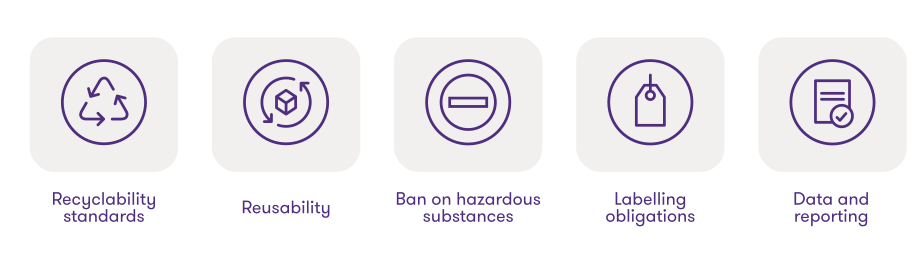
The initial obligations cover five key areas. Together they reshape how packaging is designed, monitored and brought to market.
![]()
- Recyclability standards. All packaging must be designed for recycling. From 2030 onwards, it must fall within recyclability classes A to C; packaging that scores below this range may no longer be placed on the EU market. In practice, you may need to redesign your packaging and assess its recyclability.
- Reusability. Specific packaging types are subject to reuse targets and obligations to set up collection and refill systems. In practice, you may need to introduce reusable formats, such as EPAL for pallets, and establish systems to collect and refill them.
- Ban on hazardous substances. Food contact packaging may not contain PFAS above established limits, and all packaging must minimise substances of concern. In practice, you may need to collaborate with suppliers to test materials and switch to PFAS-free alternatives.
- Labelling obligations. All packaging must use harmonised EU labels and pictograms for waste sorting, packaging composition and reusability. This replaces existing national symbols. In practice, you need to update your packaging label design to meet the new EU labelling requirements.
- Data and reporting. Each packaging type requires a Declaration of Conformity supported by a technical file, including material specifications, test results and recyclability assessments. These must be retained for at least five years. In addition, producers must register in each market where packaged products are sold. In practice, you need to establish effective data management and reporting processes to collect and provide the required compliance documentation when requested by authorities.
Not every detail is finalised yet, and the scope continues to evolve. Key elements, such as recyclability criteria and requirements for recycled content, will be further defined through implementing acts and introduced gradually over the coming years. Recent updates have already adjusted, for example, requirements for pallet wrapping and straps. This means organisations are already making important design decisions while the framework is still being refined.
Expect further clarification and use this as an opportunity to build a flexible, future-proof approach that can evolve alongside regulatory developments.
Who’s affected?
If you place packaging or a packaged product on the EU market, the PPWR applies to you. Its scope is broad: it covers all packaging placed on the market, whether produced in the EU or imported, B2B or B2C, sold in-store or online, ranging from primary packaging to transport packaging. This affects manufacturers, distributors, retailers and e-commerce businesses alike.
Examples:
- A furniture retailer importing flat-pack goods is responsible for the boxes, foam and film used for each item.
- An online-only cosmetics brand is responsible for its shipping boxes and product packaging.
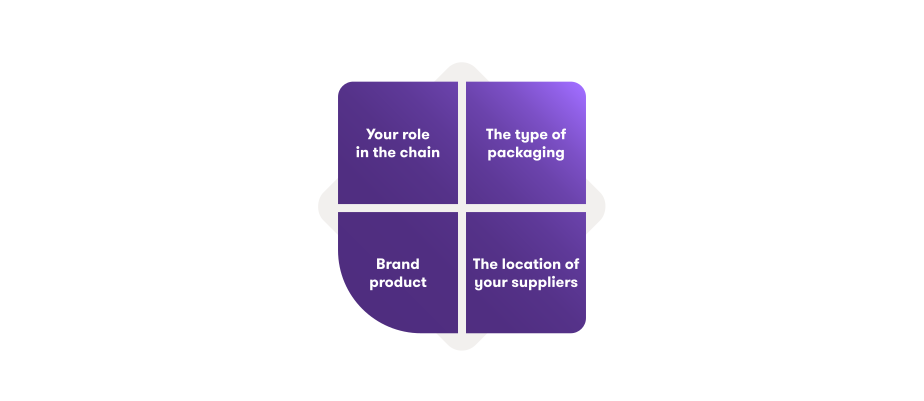
How much lands on you, and in which role, depends on four things:
- your role in the chain (e.g. supplier, manufacturer, importer, distributor, and producer);
- the type of packaging;
- whether the packaging carries your private label;
- the location of your suppliers.
![]()
Two factors are particularly important. If your name or brand appears on the packaging, you are considered a “Producer” under the PPWR and carry the heaviest responsibility for reporting. If your suppliers are located outside the EU, you are also classified as a “Producer” and inherit responsibilities that would otherwise apply to an EU-based company.
If neither situation applies, you may have a different PPWR role. The regulation defines multiple roles, each with its own responsibilities, such as preparing the Declaration of Conformity, registering for Extended Producer Responsibility (EPR), or performing due diligence checks. In practice, many organisations hold multiple PPWR roles across different packaging types, meaning they manage several sets of responsibilities at the same time.
Example: A packaged food wholesale company sells packaged food products to retailers.
- For its products sold under its own brand, such as bags of rice and pasta sauce, it is considered the “Producer” and “Manufacturer”.
- For products supplied by other brands, it may have a different role, such as “Distributor”.
PPWR impacts your operations, strategy and risk management
For many organisations, the PPWR may initially appear to be a compliance exercise. However, it goes beyond compliance. It affects how packaging is designed, sourced, documented, and managed across the entire value chain. Its impact extends simultaneously to operations, strategy and risk management.
Operational impact
- Redesign packaging to meet requirements for recyclability, recycled content, material reduction and labelling.
- Adjust operational processes, including packaging optimisation, reuse models and supplier collaboration.
- Develop the packaging data and documentation required to demonstrate compliance and support reporting.
Strategic impact
- Integrate packaging requirements into product development, procurement and investment decisions.
- Strengthen visibility and control across the value chain through improved supplier engagement and data governance.
- Use the PPWR as a driver for innovation, circularity and long-term competitiveness.
Risk and compliance impact:
- Safeguard access to the EU market by ensuring packaging meets compliance requirements.
- Reduce exposure to enforcement measures, fines and operational disruptions.
- Protect your reputation by supporting sustainability claims with reliable and verifiable evidence.
Start now: compliance cannot be developed overnight
Although the PPWR starts applying from August 2026, many of the capabilities required for compliance cannot be developed overnight. Gaining insight into packaging portfolios, obtaining supplier data and building robust compliance processes all take time. Preparation is therefore not only defensive, but also an opportunity.
Companies that start early can:
- strengthen resilience as demand for compliant packaging solutions and supplier support increases;
- spread investments and operational changes over time and with focus rather than implementing them under pressure;
- turn compliance into a competitive advantage by building trust with customers, business partners, and regulators.
- build stronger brand and customer trust by being able to back up their sustainability story and make a genuine positive impact on the resources we all depend on.
The transition is already underway. Organisations that act now will be better positioned to manage regulatory change while creating value.
How to prepare: five practical steps to get started
Start by building a clear overview of your packaging landscape: what packaging you use, where it enters the market and where the main risks are. The objective is to identify high-risk packaging types, understand your role in the value chain and focus efforts where you have the most influence. Reliable data is essential: establish strong data governance and engage key suppliers early to ensure packaging data remains accurate and scalable.
Here are five concrete steps to get your started:
- Map your packaging landscape: identify which packaging types you use and in what volumes.
- Determine your role per packaging type: establish whether you act as a producer, importer, brand owner or in another role.
- Collect technical data and information: gather details on materials, composition, recyclability and the data required for the declarations.
- Set up data management processes: organise how you collect, validate and maintain this information.
- Engage key suppliers: ensure access to reliable packaging data and verify ongoing compliance.
How we can help
- We support organisations in preparing for the PPWR and translating it into a structured, future-ready approach, including :
- A free consultation to assess whether the PPWR applies to your organisation
- PPWR scoping with an initial impact and risk assessment translated into a practical roadmap
- Setting up governance and internal control processes
- Integrating circularity into your strategy and policies to unlock business opportunities
- Stakeholder and value chain engagement to improve collaboration
- Broader circularity support, including strategy, implementation, reporting and tools such as LCA and EPD
Would you like to discuss these insights? Get in touch with us.
Get in touch